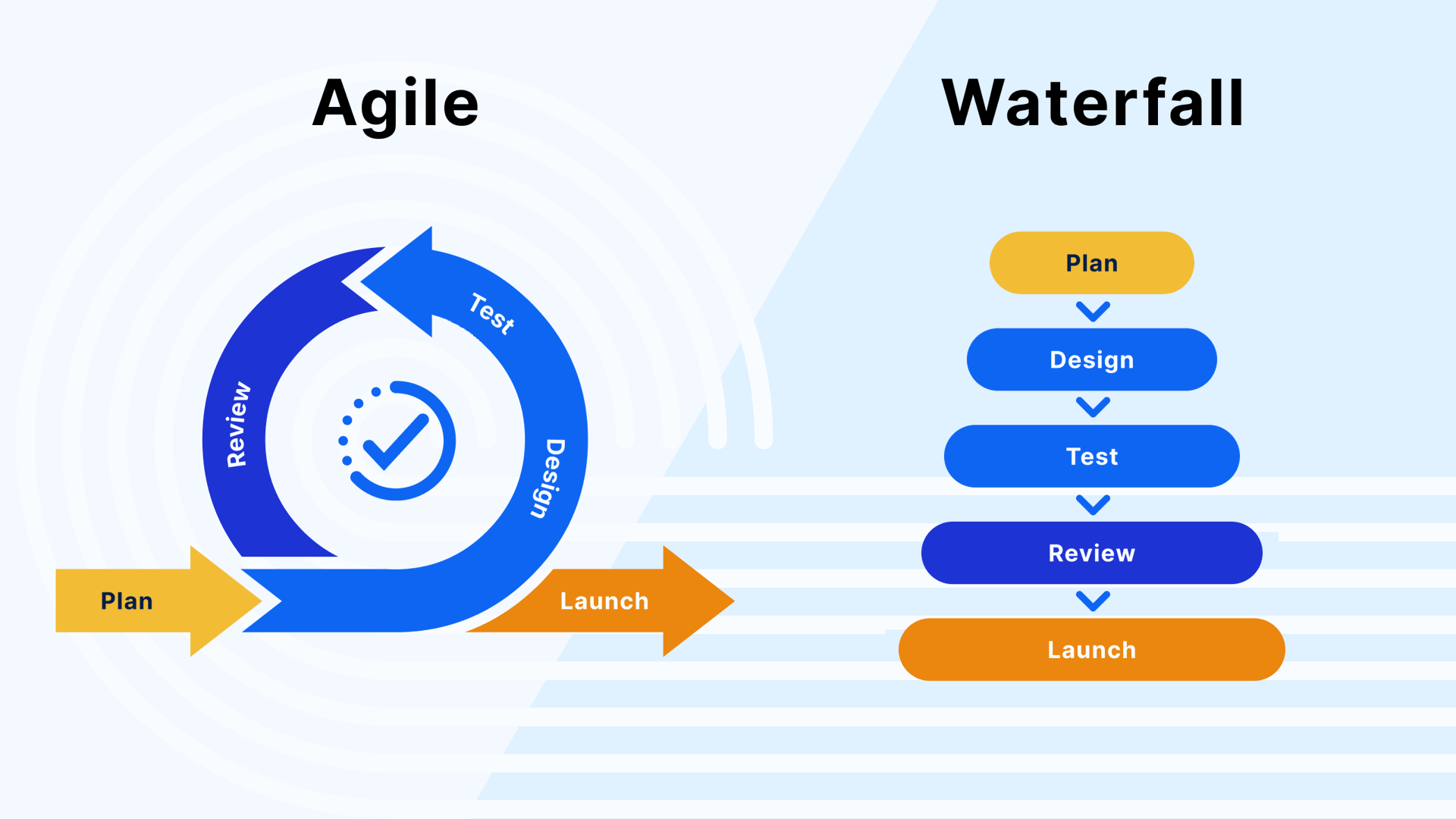
Two approaches, two very different philosophies. Choosing between Agile and Waterfall could be one of the most important decisions you make for your next project.
Agile vs Waterfall: Which Project Management Method Should You Use?
If you're planning a new project — whether it's a software build, a website, a product launch, or an internal process overhaul — at some point you'll face a fundamental question: how should we actually manage this? Two approaches dominate the conversation: Agile and Waterfall. They're very different in philosophy, in practice, and in the results they produce.
This guide breaks down both methods honestly — what they are, how they work, where they shine, and where they fall apart. By the end, you'll have a clear sense of which one fits your situation, and why it matters more than most people realise.
What is the Waterfall Method?
Waterfall is the traditional approach to project management. It works in a strict, linear sequence — like water flowing down a series of steps, each one leading to the next. The typical stages look like this:
- Requirements — gather and document everything the project needs to deliver
- Design — plan how it will be built
- Development — build it
- Testing — check that it works correctly
- Deployment — release it to users
- Maintenance — fix issues that arise after release
The key rule of Waterfall is that each phase must be fully completed before the next one begins. You don't start building until the design is signed off. You don't test until everything is built. You don't release until testing is complete. It's orderly, predictable, and easy to understand.
Waterfall has been the dominant project management approach since the 1970s, and it works well in the right context. But it has one major weakness: it assumes that requirements are known, stable, and correct from the start. In practice, that's rarely true.
What is the Agile Method?
Agile takes a fundamentally different approach. Rather than planning everything upfront and delivering all at once, Agile breaks work into short cycles — delivering small, working results frequently, gathering feedback, and adjusting as you go.
Instead of a straight line from start to finish, Agile works in loops. Each loop delivers something real, gets evaluated, and informs the next loop. This means problems get caught early, changes are welcomed rather than feared, and the end result is much more likely to match what was actually needed.
Agile is a mindset and a set of values — not a single fixed process. In practice, teams implement it through frameworks like Scrum (which uses fixed sprints) or Kanban (which uses a continuous flow). If you'd like to understand Agile in more depth before diving into the comparison, our full Agile methodology guide is a good place to start.
Agile vs Waterfall: The Key Differences
Here's how the two approaches compare across the dimensions that matter most in real projects:
- Planning: Waterfall plans everything upfront before any work begins. Agile plans just enough to get started, then re-plans continuously throughout the project.
- Flexibility: Waterfall resists change — a requirement change mid-project can be very expensive. Agile embraces change as a normal and expected part of the process.
- Delivery: Waterfall delivers the final product at the end. Agile delivers working results continuously, often as frequently as every one to two weeks.
- Customer involvement: In Waterfall, the client is heavily involved at the start (requirements) and end (delivery). In Agile, the client is involved throughout — reviewing work regularly and giving ongoing feedback.
- Risk: In Waterfall, risk accumulates silently and often only becomes visible late in the project. In Agile, risks surface quickly because you're building and testing in short cycles.
- Documentation: Waterfall relies heavily on detailed documentation. Agile values working output over documentation, though good Agile teams still document what matters.
- Team structure: Waterfall teams tend to be hierarchical, with a project manager directing work. Agile teams are more self-organising and collaborative.
When Waterfall Works Best
Waterfall is not obsolete — it's genuinely the right choice in certain situations. It works best when:
- Requirements are fixed, clear, and unlikely to change — for example, building to a precise regulatory specification or delivering a defined scope under contract
- The project has strict dependencies where each phase truly must complete before the next begins — construction and manufacturing are classic examples
- The team is distributed or large and needs clear handoffs between departments or contractors
- There is no tolerance for ambiguity — government projects, compliance-driven work, or safety-critical systems often fall here
- The client wants a fixed price and fixed scope contract, where Waterfall's upfront planning makes the agreement easier to define
The honest summary: Waterfall is excellent when you know exactly what you're building and nothing will change. The challenge is that this situation is rarer than most project plans assume.
When Agile Works Best
Agile thrives in situations where uncertainty, change, or speed of delivery are factors — which describes the majority of modern business projects. It works best when:
- Requirements are likely to evolve — the product is new, the market is changing, or the client is still discovering what they need
- You need to deliver value quickly rather than wait months for a complete product
- The team is small and collaborative, able to communicate frequently and adapt quickly
- Client or user feedback is essential to getting the product right — software, apps, digital marketing campaigns
- You're working in a fast-moving environment where being wrong quickly is better than being wrong expensively
Agile is now the dominant approach in software development, digital product teams, and increasingly in marketing, operations, and business process work. Its principles — visualise work, limit multitasking, deliver frequently, improve continuously — apply almost universally.
One of the easiest ways to start working in an Agile way is to visualise your tasks on a Kanban board. SimplyKanban is a free online Kanban board that lets your team put Agile principles into practice immediately — no setup, no training, no cost.
The Real-World Problem with Waterfall
Here's a scenario that plays out constantly in business. A company decides to build a new customer portal. They spend two months gathering requirements. Another month on design. Four months building. Two months testing. Then they show it to actual users for the first time — and discover that several key features aren't how users expected them to work, one critical workflow was misunderstood from the start, and the market has shifted slightly since the requirements were written.
Now they face a choice: ship something imperfect, or go back and rework months of effort. Either way, it's expensive and demoralizing. This isn't a failure of the people involved — it's a structural weakness of the Waterfall model. Feedback came too late.
With Agile, those same users would have been reviewing working prototypes every two weeks. The misunderstanding would have surfaced in week three. The adjustment would have cost days, not months.
Can You Use Both? The Hybrid Approach
In practice, many teams don't pick one method and rigidly stick to it. Hybrid approaches are common and often sensible. For example:
- Use Waterfall-style planning for the overall project structure and budget, while running Agile sprints within each phase
- Use Waterfall for the parts of the project with fixed requirements (legal, compliance, infrastructure) and Agile for the parts that need flexibility (UX, features, content)
- Start with Waterfall's upfront planning to satisfy stakeholders who need a fixed plan, then apply Agile execution to stay responsive once work begins
The goal isn't methodological purity — it's delivering good results. Use whichever combination of tools and principles helps your team do that.
Agile vs Waterfall: A Quick Summary
If you're trying to decide right now, here's the simplest version:
- Choose Waterfall if your requirements are fixed, your scope is defined, and change is unlikely or unwelcome.
- Choose Agile if your requirements may evolve, you want to deliver value quickly, and you need the flexibility to adjust as you learn.
- Consider a hybrid if your project has elements of both — rigid constraints in some areas, flexibility needed in others.
When in doubt, lean Agile. The cost of over-planning a project that ends up changing is almost always higher than the cost of adapting a flexible plan.
Conclusion
Agile and Waterfall aren't enemies — they're tools. Each was designed to solve a specific type of problem, and each does its job well in the right context. The mistake most teams make is applying one rigidly to every situation, regardless of fit.
Understanding both methods gives you the ability to make a conscious choice rather than defaulting to habit. And making that choice thoughtfully — before your project starts — is one of the most valuable things you can do for its success.
If you're leaning toward Agile and want to start putting it into practice, a visual task board is the natural first step. Create a free account on SimplyKanban and have your team's work visible, organised, and moving forward within the hour. And if you'd like to explore how Norn Technologies can help you build custom web applications that fit exactly how your team works — Agile, Waterfall, or anywhere in between — get in touch with us here.