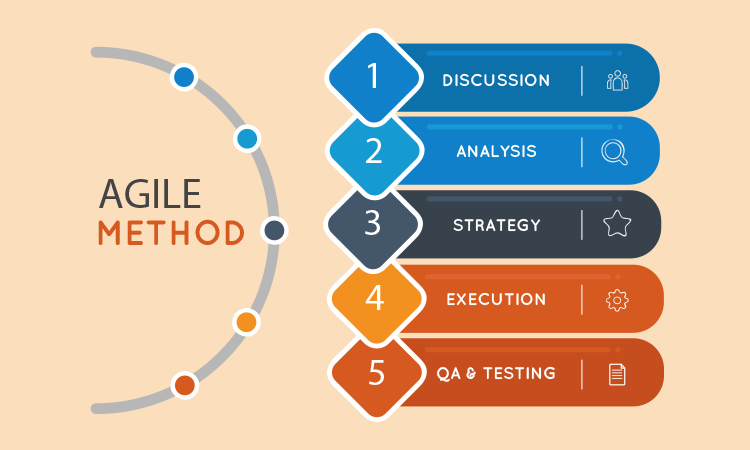
Agile is not a tool or a software — it's a mindset. And once you get it, it changes how you think about every project.
What is Agile Methodology? A Plain English Guide
If you've been around any tech team, startup, or modern business in the last decade, you've almost certainly heard the word "Agile." It gets thrown around constantly — in job descriptions, project pitches, team meetings. But ask five people what it actually means and you'll get five different answers. Some will talk about sprints. Others will mention standups. A few will recite the Agile Manifesto like a prayer.
So let's cut through the noise. What is Agile methodology, really? And more importantly — does it actually help, and should your team be using it?
What is Agile? The Short Version
Agile is a way of managing projects that focuses on delivering work in small, frequent chunks rather than one big delivery at the end. Instead of planning everything upfront and hoping nothing changes (it always does), Agile teams plan a little, build a little, get feedback, and adjust. Then repeat.
The goal is to stay flexible, catch problems early, and consistently deliver value — rather than spending months building something only to discover it's not quite what was needed.
Where Did Agile Come From?
Agile as a formal methodology was born in 2001, when seventeen software developers got together at a ski resort in Utah and wrote what became known as the Agile Manifesto. They were frustrated with traditional project management — long planning phases, rigid processes, mountains of documentation — that often resulted in software delivered late, over budget, and not quite right.
Their manifesto was refreshingly simple. It outlined four core values:
- Individuals and interactions over processes and tools
- Working software over comprehensive documentation
- Customer collaboration over contract negotiation
- Responding to change over following a plan
Notice the wording — it doesn't say processes, documentation, contracts, and plans are bad. It says the items on the left matter more. That nuance is important and often gets lost when people describe Agile as "just winging it."
The 12 Agile Principles (Without the Jargon)
Beyond the four values, the Agile Manifesto includes twelve principles. Rather than listing them verbatim, here's what they really mean in practice:
- Deliver working results early and often — don't wait until everything is perfect
- Welcome changing requirements, even late in the project — the world changes, your plan should too
- Work closely with your customer throughout, not just at the start and end
- Build projects around motivated people and trust them to get the job done
- Face-to-face conversation is the most effective way to share information
- Working output is the primary measure of progress — not documents or plans
- Maintain a sustainable, steady pace — burning out your team is not a strategy
- Continuously look for ways to improve — both the product and how you work
How Does Agile Work in Practice?
Agile itself is a philosophy, not a specific set of rules. In practice, teams implement Agile through specific frameworks — the most popular being Scrum and Kanban. Think of Agile as the "why" and frameworks like Scrum or Kanban as the "how."
Scrum breaks work into fixed time periods called sprints, usually one to two weeks long. At the start of each sprint, the team picks a set of tasks to complete. At the end, they review what was built and plan the next sprint. It's structured, predictable, and works well for teams building software or complex products.
Kanban is more fluid. There are no sprints — work simply flows continuously through stages from "To Do" to "In Progress" to "Done." Teams limit how much work is active at any time, which prevents overload and keeps things moving. If you're curious how Kanban works as a visual system, our guide to Kanban boards covers it in detail.
For teams that want to get started with Kanban right away, SimplyKanban is a free online Kanban board that takes minutes to set up — no training or onboarding needed.
Agile vs Traditional Project Management
To understand why Agile became so popular, it helps to understand what it replaced. Traditional project management — often called the Waterfall model — works like this: you gather all requirements upfront, write a full plan, build the entire thing, test it, then deliver it. Each phase must be fully completed before the next begins.
This works fine when requirements are crystal clear and nothing will change. But in reality — especially in software development, marketing, and product work — requirements change constantly. New information appears. Clients change their minds. The market shifts. With Waterfall, you often discover these changes too late, when most of the budget is already spent.
Agile solves this by building in regular checkpoints and feedback loops. Problems surface after days or weeks, not months. Changes are expected, not feared.
What is Agile Project Management?
Agile project management applies Agile principles to the process of planning and running projects. Instead of a traditional project manager who controls a fixed plan, Agile project management involves:
- Short planning cycles — planning just enough to get started, then re-planning regularly
- Continuous delivery — releasing working results frequently rather than all at once
- Regular retrospectives — the team regularly reflects on what's working and what isn't
- Close stakeholder involvement — the client or end user is involved throughout, not just at handover
- Self-organising teams — team members take ownership rather than waiting to be told what to do
This approach has spread well beyond software. Marketing teams run Agile campaigns. HR departments manage hiring pipelines with Agile principles. Operations teams use Kanban boards to manage daily workflows. The methodology is flexible enough to apply almost anywhere work needs to be organised and delivered.
Is Agile Right for Your Business?
Agile works brilliantly when your requirements are likely to evolve, when you need to deliver value quickly rather than wait for a "big bang" release, when your team is collaborative and communicates well, or when you're working on something new where feedback is essential to getting it right.
It's less suited to projects with completely fixed, non-negotiable requirements — like building a bridge to a precise specification, or producing a legal document to a defined template. In those cases, the predictability of traditional planning has real value.
For most small businesses and growing teams, though, Agile — or even just adopting some Agile-inspired habits — tends to make work calmer, faster, and more focused. You don't have to implement the whole methodology overnight. Start with one habit: visualise your work on a board, limit how many things are in progress at once, and review your progress weekly. That alone will change how your team operates.
A great first step is setting up a free visual task board on SimplyKanban — it puts Agile thinking into practice immediately, without any theory or setup overhead.
Common Agile Terms You'll Hear
Once you start exploring Agile, you'll encounter a lot of terminology. Here's a quick reference:
- Sprint — a fixed time period (usually 1–2 weeks) in which a Scrum team completes a set of tasks
- Backlog — the full list of work to be done, prioritised by importance
- User story — a short description of a feature from the perspective of the end user (e.g. "As a customer, I want to track my order so I know when it will arrive")
- Epic — a large body of work that can be broken down into smaller user stories
- Standup — a short daily team meeting (usually 15 minutes) where everyone shares what they did yesterday, what they're doing today, and any blockers
- Retrospective — a regular team reflection session to discuss what went well, what didn't, and how to improve
- Velocity — a measure of how much work a team completes in a sprint, used to predict future capacity
- WIP limit — the maximum number of tasks allowed in progress at one time (a core Kanban concept)
Conclusion
Agile methodology isn't magic, and it's not a silver bullet. But for teams that embrace its core ideas — deliver early, welcome change, collaborate closely, and keep improving — it genuinely transforms how work gets done. Projects become less stressful. Problems surface sooner. Clients stay more informed and more satisfied.
Whether you adopt Scrum, Kanban, or simply take a few Agile principles and apply them to how your team already works, the shift in mindset is worth it. And the best part? You don't need a consultant or a certification to start. You just need to begin.
Already curious how Agile compares to the traditional Waterfall approach? Read our breakdown of Agile vs Waterfall to see which method fits your next project — and when to use each one. And if you want to try managing your work the Agile way right now, jump into SimplyKanban and set up your first board today.